Hospitals are expanding pharmacists’ roles, improving infusion center viability & strengthening shortage preparedness

Pharmacy managers face growing pressures to expand services while trying to balance patient care with financial sustainability. During a presentation at HTU, Aigner George, PharmD, HealthTrust’s Assistant Vice President, Performance Solutions, moderated a discussion with pharmacy executives about those pressures as well as potential solutions.
Preparing for the future
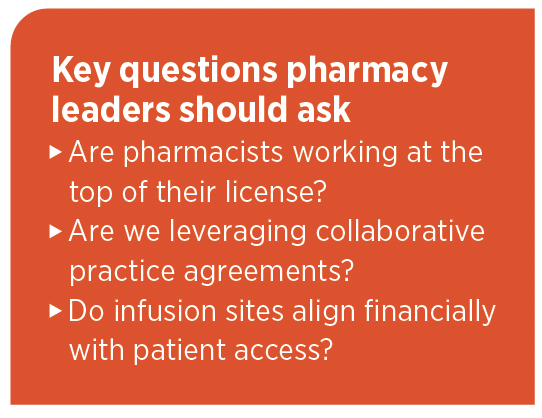
Spurred by the American Society of Health-System Pharmacists’ (ASHP) Practice Advancement Initiative, pharmacy leaders are working toward setting the profession up to meet current and future practice and payment model demands. ASHP’s recommendations are not groundbreaking. For example, creating continuing professional development plans and leveraging or expanding scope of practice. However, as panelists agreed, some of it is hard to do.

To meet the goal of advancing pharmacy roles in all practice settings, ScionHealth, which has specialty and community hospitals and senior living communities across 28 states, created collaborative practice agreements and instituted inpatient patient protocols at its long-term acute care and community hospitals, says Derek Szesny, PharmD, MPH, BCGP, Vice President of Pharmacy & Clinical Supply Utilization at ScionHealth.
For example, they’ve instituted a drug regimen review quality measure, which is applied to patients moving to a post-acute care facility. That review doesn’t necessarily need to be done by a pharmacist, Szesny says, however, “We took that as an opportunity to position our pharmacists where they are needed most and to ensure they have the right training. We provided a pharmacist with specialties in geriatric medicine and microbial stewardship to execute in that space.”
ScionHealth has also encouraged pharmacist participation and appropriate certification to support their oncology clinics across a spectrum, from managing oncology therapies to catheter management and patency. “Our team has been focusing on how to resource those hospitals with the right tools and knowledge to execute on those problems as opposed to driving a lot down from the system level,” Szesny says.
“From the point that the provider decides they’re going to prescribe a medication, the pharmacist is there to do the teaching.”
Jeanne Anderson, PharmD, MBA, BCPS
At Beacon Health System, which serves parts of Indiana and Michigan, they’ve advanced the role of pharmacy through an integrated care model, says Jeanne Anderson, PharmD, MBA, BCPS, Vice President, Pharmacy Services, at Beacon. At ambulatory and anticoagulation clinics, they’ve embedded pharmacists and support personnel to help guide oncology and rheumatology patients. “From the point that the provider decides they’re going to prescribe a medication, the pharmacist is available to do the teaching,” she says. “There is a liaison who helps with financial counseling and the prior authorization process. In most cases, we’re able to make sure those patients receive their medications more quickly than if they were to try and navigate the system on their own.”
Additionally, as a system, Beacon employs two disease management pharmacists to work with its own employees, who are part of its self-insured health plan. Employees can work with them on chronic disease management at no cost to the employees, Anderson says. “We’re seeing decreased utilization of the acute care services and better patient outcomes as a result.”
 Optimizing site of care strategy for infusion centers
With increasingly more health systems expanding into infusion centers, the pharmacy profession “wants to make sure that they’re doing things right in this space,” says Jennifer Higdon, PharmD, MBA, MS, then HealthTrust Assistant Vice President, Pharmacy Operations; now Vice President, Pharmacy Services, Ardent Health.
Part of “doing things right” for Beacon Health System, a 340B participant, is understanding that their strategy must be site-specific, says Anderson. “Anybody who works in this space knows critical access and rural referrals are subject to orphan drug exclusion, and that’s going to include a lot of your infusions,” she says. Given that, when they’re looking at site-specific strategies, they evaluate the product needed by the patient, determine if it’s only a reference product and if there’s an opportunity to shift to one of their disproportionate-share hospitals without logistically or financially disadvantaging the patient. They then investigate whether the product has a biosimilar, which might have pricing closer to what’s available through the 340B program.
Beacon has also pulled their patient zip codes and mapped them to their centers, contacting patients to see if they’d be open to going elsewhere. “Really, it goes back to staying viable and taking it to the next level,” Anderson says.
Meeting the drug shortage challenge
Facility pharmacy managers face pressure to make sure they have what they need when it’s needed, given rising demand for certain drugs, the difficulty of obtaining critical ingredients or supply chain disruptions like those caused by the COVID pandemic or extreme weather events. The most useful strategy Anderson, Higdon and Szesny have in their toolkits, they agree, is communication.
Other recommended strategies include leveraging technology to create real-time dashboards accessible at all sites, looping in business office managers in order to streamline product movement, staying in contact with partners in the field and putting in place and sharing resources that help and encourage forward thinking in order to anticipate potential supply disruption.
“It takes partnership across the entire organization, with supply chain and clinical leaders coming together, to develop the tools to ensure they are supporting one another,” says Higdon.
Listen to the full HTU 2025 session.
Share Email 340B, Employee Training, Q1 2026, Staffing, Workforce Solutions