Targeted strategies, from reject bags to AI-powered tracking, are reducing loss & improving infection control
Often viewed as simply an operational need, laundry and linen is a major driver of costs and can impact a healthcare facility’s quality scores and reimbursement. With the help of the HealthTrust team, facilities can implement strategies and tap into resources that significantly improve quality and reduce costs systemwide.
Not just clean sheets
To prevent infection and keep patients and staff safe, healthcare facilities must meet specific state and federal laundry and linen regulations. “There’s a lot that goes into ensuring everyone’s kept safe and that patient needs are met, from both an infection prevention and a patient satisfaction standpoint,” says Tara Roth, MSN, RN CENP, HealthTrust’s Director of Nursing Services, Clinical Operations.
“There’s a lot that goes into ensuring everyone’s kept safe & that patient needs are met…”
Tara Roth, MSN, RN CENP
From an infection prevention perspective, those regulations cover everything from rewash rates and water temperature to microbial colony counts and chemical concentrations. Working with laundry partners certified by the Healthcare Laundry Accreditation Council or the Textile Rental Services Association helps ensure providers understand regulatory standards and have the facilities, equipment and processes to meet them.
The HealthTrust team can help members identify and vet potential laundry service providers or provide guidance on what to look for, such as accreditation, facility standards and contamination prevention processes, says Trevor Rotondo, Director, Purchased Services Strategic Sourcing at HealthTrust.
“You’re saving on labor hours & somebody’s actually tracking it for you, so that’s something you don’t have to worry about.”
Trevor Rotondo
The team also ensures stakeholders, environmental services, nursing and infection control, are involved in the contracting process so everything from sheet specifications to infection protection protocols are addressed early. “That’s a beneficial service with a premium price tag,” Rotondo says, “but you’re saving labor hours by not sending an EVS person to do the job, and someone is tracking it for you.”
Using custom strategies to right-size linens
Besides advising about contracted suppliers, the HealthTrust team supports members’ cost and infection control goals by working with them to create custom strategies, says Bobby Self, HealthTrust’s Director of EVS, Support Services.

Linen processing is often a system’s second largest spend category after labor, Self explains. With infection protection top of mind, the HealthTrust team analyzes members’ usage and processes and looks for places where efficiencies can benefit both costs and safety.
“For example, the team began working with a large hospital system earlier this year with a savings goal of $800,000. The system is trending to save more than $1.7 million,” Self says.
To achieve these results, Self and the HealthTrust team came up with a number of tactics that the hospital system implemented. They started by examining the system’s historical data to determine exactly how much clean linen should be in patient rooms.
“Units, historically, have too much linen,” he notes. When excess clean linen is placed in a patient room, unused items are often discarded as soiled when the patient is discharged. Once the team determined a precise amount of linen per patient day, they created a new metric that would allow for easy tracking of the changes they were making. To help the hospital system meet the recommended amount of clean linen per patient day, the team proposed these specific tactics:
1 | Establish a linen committee. The committee should consist of someone from hospital administration, a clinical member, such as the chief nursing officer, someone from the infection prevention team and the EVS director. Including administration, clinical leadership, infection prevention and EVS helps align expectations with actual patient needs and shift long-standing assumptions, Self says.
2 | Use linen management software. Besides keeping track of stock, linen management software can be tailored to the health system’s management goals, so that staff using the software won’t have to do any calculations. It can also record and track historical volume to more easily understand fluctuations, eliminating the need to have staff manually count stock. This in turn reduces physical handling and limits contamination risks.
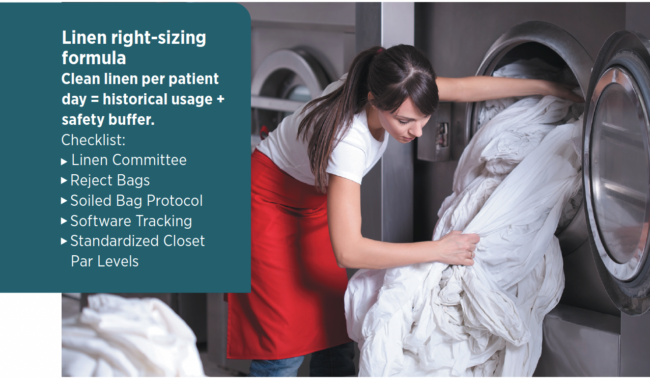
3 | Adopt reject and soiled linen bags. Laundry service providers don’t want to deal with torn and worn textiles, which can cause issues with equipment and are hard to effectively clean because they can harbor microorganisms, and facilities don’t want bedding with holes in it because shoddy bedding can negatively affect patient satisfaction scores. With these things in mind, train hospital staff to examine bedding when making up beds, and put torn and worn bedding into “reject” bags. Likewise, train housekeeping staff to carry a “soiled” bag on their carts in addition to trash, with the goal of all soiled linens going into the soiled bag instead of accidentally going into the trash, which cuts down on loss, Self adds, and the hazards of soiled linens going into the waste stream.
Looking ahead, Self says the HealthTrust team is exploring additional strategies to enhance efficiency and strengthen infection prevention efforts. One approach involves establishing par levels for each linen type that align with patient-volume demands in the centrally located clean linen storage rooms. Historically, these rooms contained an excessive number of storage racks, which led to chronic overstocking and made effective management difficult.
Another tactic is to work with developers of linen management software to take advantage of artificial intelligence. “Leveraging AI in the future is going to be huge,” Self says, with the expectation that it will make some real improvements in the laundry and linen space. As these technologies mature, AI could transform linen operations from a reactive necessity into a strategic advantage.
Get connected. HealthTrust can help your organization adopt smarter, data-driven linen strategies—including emerging AI-enabled tools—to create safer, more efficient environments. Email commercial@healthtrustpg.com to get started.
Share Email Facilities Management, Infection Prevention, Operations, Performance Improvement, Q1 2026