From the nurses’ station to the OR, AI is improving efficiency & patient care
From streamlining supply chains to simplifying staff scheduling to enhancing patient care, hospitals and health systems are using artificial intelligence (AI) in a multitude of ways—even as they grapple with reservations about the technology. While research indicates AI can help care teams work more efficiently, make better informed decisions and improve the patient experience, today’s healthcare leaders find themselves trying to balance the potential benefits with best practices and responsible use.
What’s on paper doesn’t always translate seamlessly into real-world practice, so we turned to HealthTrust members to learn how they are using AI. These stories highlight how hospitals and health systems are applying the technology to improve efficiency, support clinicians and enhance the overall patient experience. Partnering for innovation:

AI in surgical practice at Orlando Health
Reducing medical waste is a big issue for the surgery department. In the operating room, if an item is removed from its sterile packaging, it must be disposed of, even if it wasn’t used. Surgeons at Orlando Health and undergraduate engineering and computer science students at the University of Central Florida (UCF) tackled that problem.
After observing Alexis Sanchez, M.D., Director of Robotic Surgery at Orlando Health, perform a robotic surgery at the academic healthcare system, Laura Brattain, a UCF biomedical engineer, discussed with Dr. Sanchez the possibility of using UCF students to develop an AI system that would track how many surgical staples are used in surgery.

“What’s important is to build translational technology so we can see that it’s making an impact,” says Brattain. “We don’t want it to be developed and then collect dust on the shelf.”
Taking an AI program that tracks cafeteria forks as a starting point, the UCF students created the Artificial Intelligence for Medical Surgery (AIMS) system. AIMS links a camera in the operating room to AI software, recording each staple that comes into the OR and tracking its use. The data is then analyzed to determine how many staples are actually used, which informs clinicians how many surgical staples are truly needed. This process ultimately improves efficiency, reduces medical waste, the cost of care and the valuation of instrument disposal.
The AIMS system was tested by students in the OR to see if it worked as expected. Once they saw the OR’s specific conditions, they made improvements to the program. Dr. Sanchez uses AIMS when he conducts surgeries and describes the collaboration as important. “It brings together the best minds, academic innovation paired with clinical experience, for the ultimate goal of improving patient care,” he says. The hope now is that similar technology will be implemented in other settings across the entire enterprise.
Mercy Health: Streamlining nursing documentation with AI
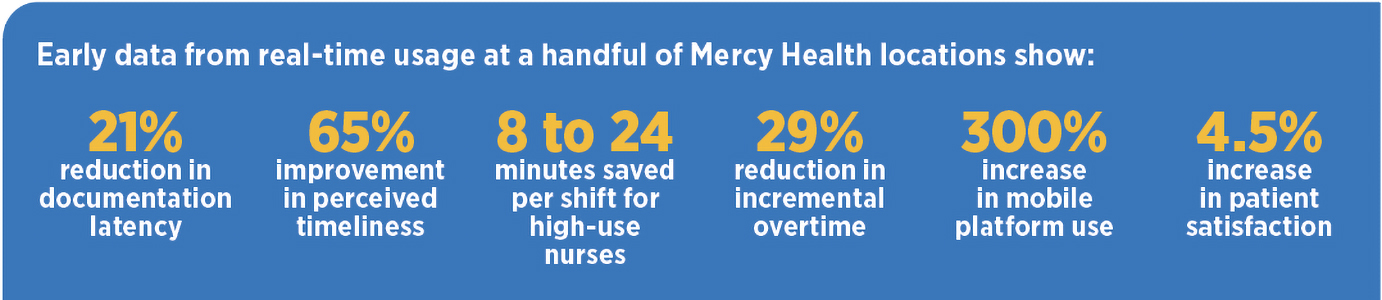
As any nurse will say, documenting patient interactions takes significant time, and having to focus on note-taking often means they aren’t interacting with patients to the degree they—and their patients—would like. Through a partnership with Microsoft, nurses at Mercy Health, a multistate health system, are helping to design an ambient AI tool specifically for nurse workflows.
Built off of Microsoft’s Dragon Copilot, this AI-based clinical assistant platform is designed to streamline documentation, automate routine tasks and make important clinical information easily accessible. The tool uses voice dictation and ambient listening capabilities, then integrates the interaction into Mercy’s electronic health record (EHR) system.

After obtaining consent from a patient, a nurse turns on the ambient AI tool, which “listens” as the nurse and patient talk. It simultaneously transcribes the real-time conversation into notes that the nurse reviews and approves before the information is added to the EHR.
Mercy is one of nine health systems across the country working closely with Microsoft and front-line nurses to shape the technology. Medical-surgical nurses at Mercy participated in the Copilot development by narrating their care in real time to help test and improve the system.
“Many of our nurses have said that by narrating as they provide care, they’re noticing their documentation is much more robust,” says Stephanie Whitaker, MSN, RN, Chief Nursing Officer at Mercy Hospital Fort Smith.
Advancing AI at HCA Healthcare
Recognizing there was a significant opportunity to improve care and workflows with the use of AI, HCA Healthcare launched an intentional digital transformation informed by leaders in key areas—Nursing, Internal Revenue Cycle and Supply Chain, among others—that focused on the thoughtful development of AI solutions.

Early in HCA Healthcare’s digital transformation journey, it partnered with Google to explore generative AI applications. One project, which allows physicians to use ambient AI and speech-totext technology via a hands-free device, was developed in partnership with Augmedix, a healthcare technology company specializing in ambient medical documentation. The device transcribes medical information relayed during conversations between physicians and patients into medical notes that are added to the patient’s EHR after being reviewed and approved by the physician. When this project was piloted, physicians reported strong overall satisfaction with the tool and process.
Another generative AI project that emerged from the Google collaboration is a tool called Nurse Handoff. “The nurse handoff process at shift change involves a lot of information exchange,” says KC DeShetler, RN, HCA Healthcare’s product owner for Nurse Handoff. “We saw that the existing process was manual, time-consuming and without standards, so it was a good test case for a large language model application.”
Nurse Handoff uses an AI-linked device to pull key information from a patient’s EHR and then creates a summary to guide shift-change reports for nurses. The tool reduces manual chart reviews, lessens the chance of information being overlooked and improves communication between shifts.

When the tool was piloted in several facilities, patient safety improved, nurse engagement was over 90% and feedback was positive, explains Sarah Bryant, RN-BC, Vice President, Care Team Optimization & Transformation at HCA Healthcare. What they learned, Bryant says, was “if we want to ensure nurses adopt this and truly shift their practice, then we must have the information displayed in a way that they can easily articulate and digest. It must support their workflows and practice.”
Once that happened, the nurses loved it. The tool is now being piloted at more facilities within HCA Healthcare with the hope that it will soon be used at all sites.
As these scenarios illustrate, using AI is not about replacing people—it’s about equipping people with the right tools. “AI can be seen as a new member of your care team,” Bryant adds.
YOUR TURN
Connect with HealthTrust to share how your organization is using AI to improve patient care. Post it to the HealthTrust Huddle or email Executive Editor Faye Porter at thesource@healthtrustpg.com