Preparing infrastructure to support the demands of AI expansion
Artificial intelligence (AI) is no longer a “what if” in healthcare operations. It’s being put into practice across a number of different areas in tasks such as clinical documentation, patient monitoring, automated revenue cycle workflows and assisting with diagnostics, to name a few.

However, as health systems accelerate AI adoption, some of the challenges are in memory and storage, power and cooling, and governance. “This is an emerging challenge and one that many leaders may underestimate,” says Nick Crowe, Director of IT Strategic Sourcing for HealthTrust.
As health systems scale AI-enabled workloads, they are confronting constraints in semiconductors and storage, rising power and cooling demands, and organizational realities that make operationalizing it far more complex than deploying traditional IT tools. For leaders trying to forecast and then be held accountable to a budget, understanding the demands are critical.
AI in practice & under pressure
AI’s use cases in healthcare are already diverse and expanding. “Consider ambient listening technologies that lessen the documentation burden on physicians,” says Clay Posey, Assistant Vice President of IT Strategic Sourcing for HealthTrust. Another example enables clinicians to focus more fully on patients through virtual nursing and sitting programs. These use video intelligence to detect motion, bed rail changes or signs that a “fall risk” patient may attempt to get up unassisted.
In revenue cycle applications, AI tools are beginning to review payer rejections and identify missing documentation to streamline resubmissions. In radiology, some FDA-approved solutions are already assisting with first reads, though the oversight of a radiologist remains essential. (Read more in A Smarter Path to Radiology AI Adoption)

AI systems still carry risk, particularly around “hallucinations,” which Posey describes as “instances where models generate inaccurate outputs. In a field where patient safety is the mission, even a small error rate is cause for concern.
“According to NP Digital Medicine, ambient AI scribe solutions utilizing large language models can have overall hallucination rates of 1% to 3%, while some solutions can experience hallucination rates of 20% to 30%,” Posey explains. And the stakes are obviously higher in healthcare than in most industries. Even when AI tools are clinically validated, the underlying infrastructure challenge remains—can it support them reliably and sustainably?
Semiconductor & storage issues
At the heart of the infrastructure crunch is a global supply shift driven by large AI players.
High-end memory and processing storage components are increasingly being absorbed by hyperscale AI data centers. Meanwhile, production constraints and strategic manufacturing shifts are tightening supply of the units.
Compounding the issue, some manufacturers have reduced production and prioritized more profitable AI components over traditional enterprise hardware. The result is longer lead times, pricing pressure and contract instability that can make its way down to health systems.
As suppliers redirect capacity toward high-performance AI infrastructure components and GPU memory, lower-margin enterprise devices such as laptops, desktops and workstations are also impacted.
Unfortunately, the forecast doesn’t seem to be short-term. “It will be into the fourth quarter of 2027 or later based on the current data before we see any kind of supply reset,” Posey says.

For health systems planning refresh cycles or expansion initiatives, that timeline matters. It may mean reevaluating asset lifecycles, extending refresh cycles from three years to five or even seven where feasible, and scrutinizing line-item price increases rather than accepting broad percentage hikes.
HealthTrust’s role, Crowe emphasizes, is to ensure members understand what is happening upstream. “We’re here to make sure you’re aware of what’s going on and investigate potential avenues for solutions,” he says.
If infrastructure planning continues to lag behind AI strategy, health systems may face hardware shortages which can result in stalled deployments, deferred refresh cycles and potentially going over budget when it comes to the rising cost of components.
Power & cooling
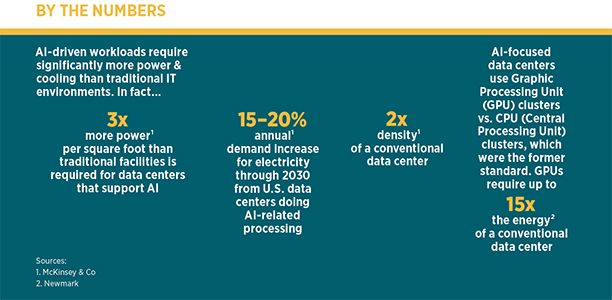
Even when hardware is available, running large-scale AI workloads demands significantly more power and cooling than traditional IT environments.
“High computing power increases the heat generated when the machines are operating,” explains Mark Coleman, Director of IT Sourcing for HealthTrust. “It comes down to raw power.”

Healthcare facilities have unique requirements. Uptime is non-negotiable. IT workloads supporting clinical care cannot fail mid-procedure or during patient monitoring. That elevates the importance of robust uninterruptible power supply (UPS) systems, backup power infrastructure and advanced cooling technologies, including liquid cooling in some environments.
Even organizations relying primarily on cloud platforms are not insulated. Data ingestion, hybrid storage models, edge devices and backup infrastructure still require local capacity.
Meanwhile, large-scale AI data centers are straining regional power grids. In parts of the country, new data centers have been told they will not be able to connect to the grid for years due to capacity limitations. Those pressures can influence the cost of electricity for both companies and consumers.
Through HealthTrust contracts, suppliers like Vertiv are working with healthcare organizations to address these challenges by providing power distribution solutions, advanced cooling systems and resilient, specialized backup infrastructure designed for high-performance environments.
Operationalizing AI: Governance matters
In addition to some of the technical challenges of infrastructure, there are organizational considerations as well.
Rolling out AI tools requires workflow redesign, clinical oversight and dedicated governance structures. Mature integrated delivery networks (IDNs) are increasingly creating interdisciplinary teams that include IT architects, developers, clinicians (or other appropriate subject matter experts) as well as project managers.
“For adoption to be successful, clinical and operational leaders need to collaborate on developing the deployment and governance strategies,” Posey says.
Some health systems have even built dedicated AI divisions to coordinate efforts across facilities. Without that alignment, AI initiatives risk stalling—not because the technology fails, but because workflows do.
Budgeting for what’s next
As health systems work on budgets, leaders may need to rethink how AI investments are structured. Rather than making heavy capital expenditures for on-premises buildouts, some experts recommend leveraging public cloud infrastructure, where possible.
“I’d suggest making it an operational expense,” Posey says. “Utilize a cloud service provider that already has the infrastructure in place instead of trying to build the infrastructure within your facility.”
Crowe shares that attempting to build full in-house capacity for current and future AI needs could be prohibitively expensive. Strategic partnerships, infrastructure-as-a-service models and detailed utilization audits may offer a more sustainable path forward.
Even with these constraints, AI systems continue to demonstrate measurable value. “Not only is the tech mind-blowing,” Coleman adds, “but it is also driving toward better outcomes and an improved patient experience.”
AI may be software-driven, but its success in healthcare will ultimately depend on storage capacity, semiconductor supply, power availability, cooling resilience and strategic decisions.
Healthcare organizations that plan infrastructure early, align appropriate clinical or operational leadership and build flexible financial models can create sustainable and effective AI deployments.
And in an era where innovation is accelerating, a solid and sustainable infrastructure may prove to be the real competitive advantage.
Smarter IT purchasing
Members can save money by not over-buying components, like RAM (random access memory) or storage (hard drive). Coleman, Crowe & Posey recommend:
- Thinking outside the box and utilizing the expertise of HealthTrust contracted suppliers; talk to them about how equipment will be used before placing an order
- Purchasing less sophisticated hardware, when possible, and configuring laptops appropriate to their use (i.e., machines used for normal clinical documentation have far less requirements than those used for diagnostics viewing or back-office operations)
- Exploring options such as nontraditional memory configurations (12/24GB) when you don’t need high computing capacity
- Staying in touch with the HealthTrust team to learn about new resources, such as updated configuration standards
HealthTrust contracted suppliers
Infrastructure Power & Cooling
- Vertiv Corp (Contract #104153)
Virtual Care Solutions
- care.AI (Contract #62648)
Professional Services
- AHEAD (Contract #34053)
- CDW (Contract #2500)
- SHI (Contract #81016)
YOUR TURN
Ready to identify new ways you can improve your information and technology stack? Reach out to our IT Solutions team at commercial@healthtrustpg.com