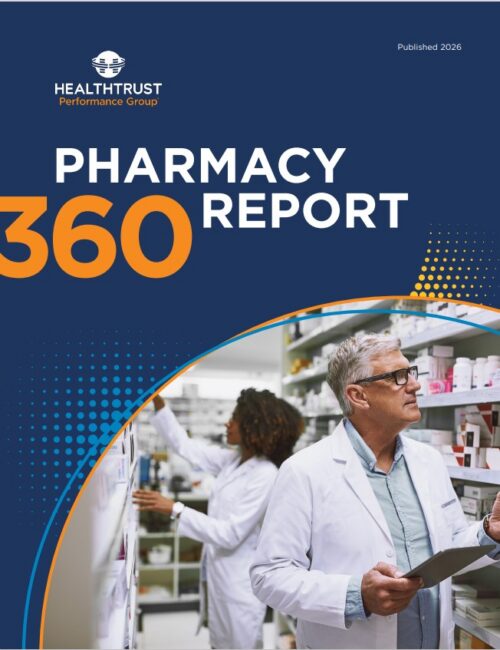
Pharmacy departments are being asked to deliver far more than traditional dispensing. Once viewed primarily as a cost center, pharmacy is now a strategic driver of revenue, outcomes and service-line growth. However, this evolution brings new pressure. Rising drug costs and persistent shortages are forcing leaders to make complex decisions in an increasingly volatile financial and supply environment. HealthTrust’s inaugural Pharmacy 360 Report distills pharmacy expertise into practical guidance for today’s drug cost, shortage and operational realities.
Rising drug costs force higher‑stakes financial decisions
In outpatient and ambulatory settings, the economics of pharmacy have shifted dramatically. The continued introduction of high-cost specialty drugs, biologics and gene-based therapies has created new revenue opportunities, but only when reimbursement aligns with investment. In 2024 alone, U.S. medication spending increased 11.4% year over year, driven largely by a small number of high-cost therapies. As a result, pharmacy leaders are facing more frequent and higher-stakes decisions about expanding into these therapies without exposing the organization to unsustainable financial risk.
As costs climb, the traditional pharmacy playbook is no longer sufficient. Leaders must balance cost containment with margin performance while supporting broader organizational growth. That requires embedding pharmacy into service-line and supply chain planning from the outset, with tight alignment across finance, clinical and operational teams. Early collaboration enables organizations to evaluate both the cost implications and revenue potential of new and innovative therapies before decisions are made.
While these financial pressures are most pronounced in outpatient and ambulatory pharmacy, their impact extends across the broader health system—shaping how organizations approach data, supply chain visibility and cost management enterprisewide.
Data & visibility are now core to margin management
Data plays a critical role in this shift. Moving beyond acquisition cost to model utilization, reimbursement variability and total cost of care allows pharmacy teams to anticipate margin impact more accurately. Third-party benchmarks and tools such as biosimilar comparison calculators can surface cost-effective alternatives and support prescribing decisions that align with payer strategy.
At the same time, visibility across the supply chain is essential. Health systems benefit from analytics infrastructure that connects pharmacy spend, drug utilization and performance metrics at the service‑line or therapeutic level. Without that transparency, it becomes difficult to quantify pharmacy’s contribution to service‑line financial performance or proactively manage rising costs. Ongoing formulary optimization, paired with strategic use of group purchasing organizations, can further improve contract performance and purchasing efficiency.
Persistent shortages require a more proactive resilience strategy
Compounding these financial pressures are ongoing drug shortages, particularly among generics. Shortages have become a persistent operational challenge, affecting patient care, workflows and budgets. In some cases, they can increase drug spend by up to 20% due to the need for alternative sourcing, therapeutic substitutions and additional labor.
Given continued fragility across global manufacturing and distribution channels, pharmacy and supply chain leaders must take a more proactive approach to resilience. Scenario planning, cross-functional response protocols and early clinician communication can help minimize disruption. Flexible inventory strategies, paired with strong alignment to programs like HealthTrust’s SIMS Drug Shortage Program, can further protect continuity of care.
As pharmacy continues to evolve, organizations that take a strategic, data-driven and integrated approach across pharmacy and supply chain will be best positioned to manage costs, mitigate disruption and unlock long-term value.
YOUR TURN
Download the Pharmacy 360 Report or email the HealthTrust team at pharmacy360@healthtrustpg.com to discuss how you can enhance your organization’s pharmacy program.